One of the most common objections to Paul being a heretic, offered by his followers, is that he was willing to die for his faith. His suffering is thought to be a debate ending proof of the validity of his message. However, is this really a solid argument? Does being a martyr or the willingness to be a martyr necessarily mean that the message or beliefs held by the individual are true? Of course, the clear answer is no. A second and related objection might be that one would never die for a lie! Is that necessarily true? Is it a fact that people do not give up their lives or “suffer” for known falsehoods? The potentially surprising answer is no. It happens all of the time and there are many examples to be found in history.
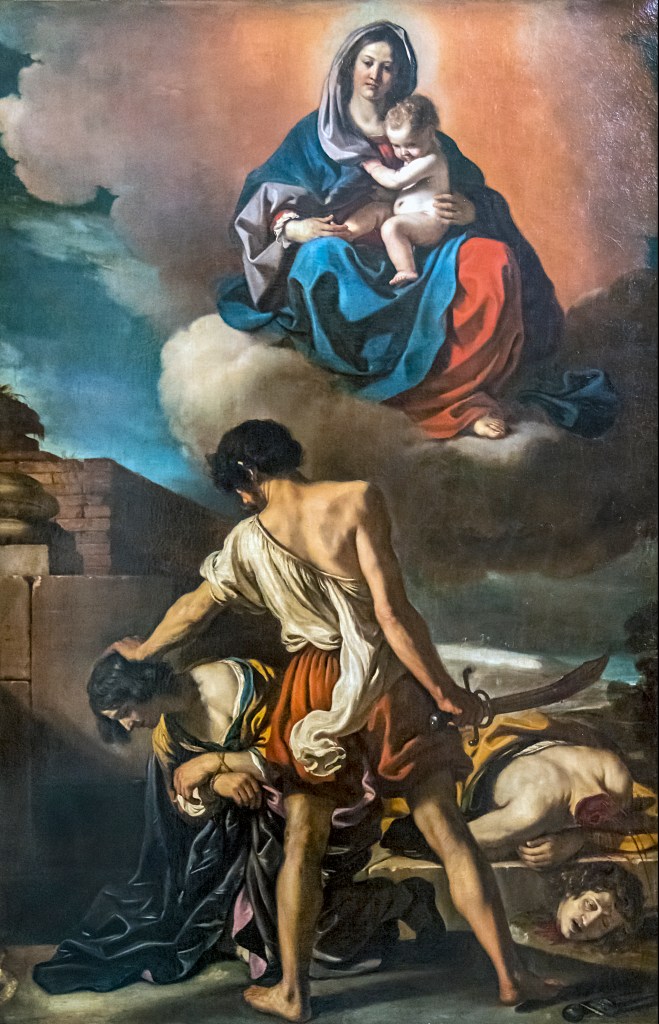
The precise details of Paul’s death are not known. Church tradition holds that he was beheaded in Rome around 64 CE. He is believed to have died as a martyr for his gospel. It is commonly thought that his death was perhaps part of the executions of Christians ordered by the Roman emperor Nero but this is just a guess. All we know is that Paul was imprisoned in Rome and wrote several of his letters during his captivity there
So, Paul was a religious martyr? Yes, he was a martyr for his faith. According to Britanica, the definition of a martyr is “one who voluntarily suffers death rather than deny their religion by words or deeds; such action is afforded special, institutionalized recognition in most major religions of the world. The term may also refer to anyone who sacrifices their life or something of great value for the sake of principle.” Paul frequently referred to his teachings as “my gospel”. Many scholars have acknowledged that indeed Paul’s version of the “gospel” was unique to him. To be sure, it was 100% his revelation and his teaching. The evidence is crystal clear that the “gospel” that Paul taught was markedly different than that of both the Messiah and the 12 true Apostles! When asked why Paul referred to his teachings as “my gospel”, one Christian Pastor suggested to the following answer which is the mainstream Christian thought on the matter:
“Short Answer. Because the risen and glorified Lord revealed the gospel of the grace of G-d to Paul alone. Not Peter or the other apostles.
The Lord revealed to the apostle Paul something new a “mystery” or secret from the Greek word mysterion (μυστήριον). A secret that had been hidden in the mind of G-d since the world began. This is why the Holy Spirit inspires the apostle Paul to use the personal pronoun “My” when referring to the gospel of grace. This new message was unique to Paul.
Adam, Noah, Abraham, Moses, Isaiah, David, Jerimiah, not even Peter, and the apostles knew anything of the gospel of grace. If they did then Paul’s epistles would be a lie. Making G-d a liar and cannot lie.”
The author is correct. Paul’s “gospel” was exclusive to him. It had never been heard until Paul, himself, proclaimed it. As an aside, notice how the Pastor capitalized the “m” in the word “my” for Paul’s gospel. This is something that is typically done when referring to the pronouns associated with G-d! Indeed, for many Christians, the divide between Paul and the divine “Christ” are blurred. In practice, they are the same. To deny Paul is to deny the divine “Christ” and thus forfeit salvation! For most Christians, one cannot deny Paul and be “saved”. This effectively makes Paul the object of salvation. Selah.
The question is, did Paul know that what he believed and taught was heresy? Did he realize that his gospel was a false gospel? My opinion is that he believed his own lie. I think that Paul had an ethereal vision. I believe that a spirit spoke to him. However, it was not the Shekinah of HaShem but a demon. Paul was unable to discern the difference and fell for the “angel of light”. Ironically, Paul warmed about this deception in 2 Corinthians 11:14 which was probably a Freudian slip (parapraxis) on his part.
Let’s return to the objection that Paul was a martyr and that this is to serve as the proof of the validity of his message. The logic is naturally flawed. Many cult leaders have willingly suffered and died for their beliefs. Examples include Marshall Applewhite, Jim Jones, David Koresh, Shoko Ashara, Luc Journet and even Simon bar Kokhba. For that matter, the famed Rabbi Akiva died as a martyr for having proclaimed Bar Kokhba as the Messiah! Clearly, Rabbi Akiva was mistaken.
Does their death PROVE their cult beliefs? The soldiers of the Nazi army died for their beliefs as did those of Imperial Japan. Are we to suggest that their willingness to die in battle validated their cause? Thousands of Viet Cong died in the War of Vietnam for what they believed. Does their death make the ideals of communism true? What about the Islamic terrorists? Scores of Muslims have blown themselves up for the sake of their religious beliefs. Should we, on that basis, accept Islam as the true faith? G-d forbid!
It is obvious that a person’s willingness to suffer and even lose their life for a cause or religious belief is by no means a confirmation of their convictions. Being a martyr does not prove anything other than the person’s commitment to their ideals. Therefore, how do we judge Paul? What is the standard by which his teachings should be either validated or declared heresy? The answer is simple: The Scriptures which are he Tanakh and the Gospels alone! Moreover, the idea that Paul would have a “unique” revelation, one not shared with the 12 true Apostles, is patently absurd. It is laughably ridiculous. It is the classic definition of a cult leader and a cult movement! That preposterous concept must be cast aside entirely.
Does Paul’s gospel comport with the Tanakh and the Gospels? Is his “gospel” the same as that taught by the Messiah and the 12 true Apostles? The honest and scholarly answer is no. That alone is the standard and nothing else. His passion and devotional are no more admirable that that of the many cult leaders of history.
 Lapid Torah Teachings
Leave a comment