
by Rabbi Mordecai Griffin
The USS Liberty Incident: History, Context, and Misuse in Contemporary Antisemitic Rhetoric
In recent years, the tragic 1967 attack on the USS Liberty has been increasingly invoked by antisemitic commentators and conspiracy-driven influencers as purported evidence that Israel is fundamentally hostile to the United States. This claim is not only historically inaccurate but represents a deliberate misuse of a complex wartime incident to advance ideological hostility toward Jews and toward the U.S.–Israel alliance. A careful examination of the historical record demonstrates that the Liberty incident was a grievous case of friendly fire during an intense regional war—not an intentional act of aggression against the United States.
Background: The Six-Day War and the USS Liberty
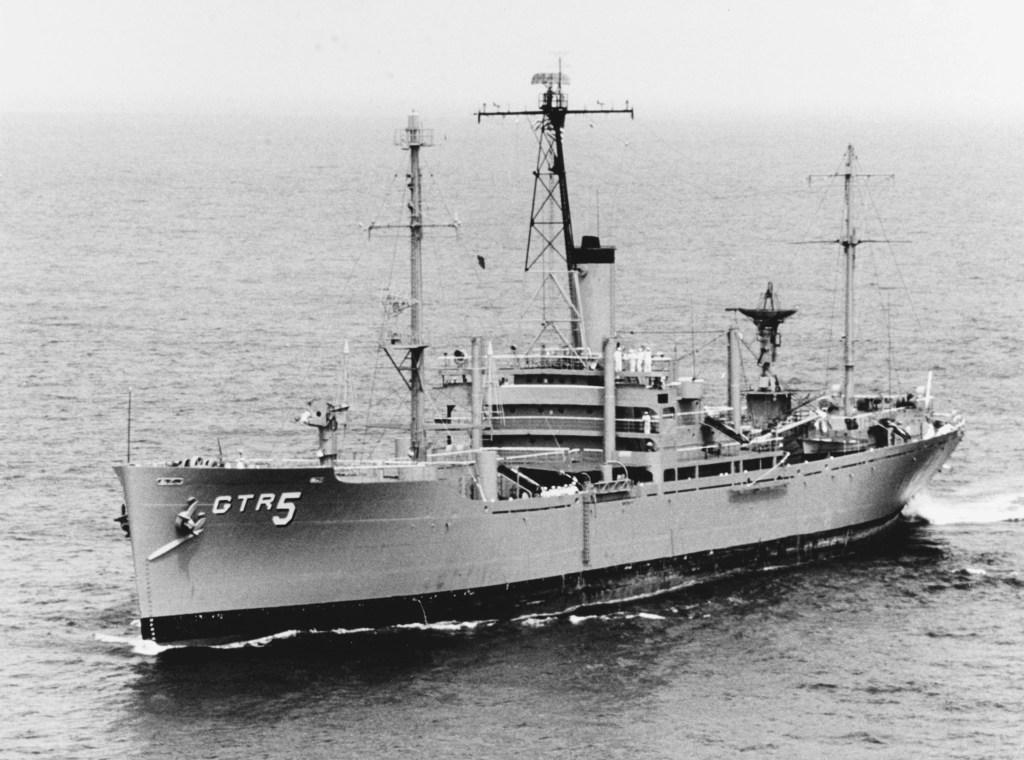
The USS Liberty (AGTR-5) was a U.S. Navy technical research ship tasked with signals intelligence (SIGINT) collection. In early June 1967, as tensions escalated toward what would become the Six-Day War, the Liberty was ordered to deploy to the eastern Mediterranean. When hostilities broke out on June 5, Israel faced coordinated military action from Egypt, Syria, Jordan, and supporting forces from other Arab states.
On June 8, 1967—three days into the war—the Liberty was operating in international waters north of the Sinai Peninsula. The ship suffered heavy casualties when it was attacked by Israeli aircraft and torpedo boats, resulting in 34 U.S. sailors killed, 171 wounded, and severe damage to the vessel.
Communication Failures and Operational Risk
Critically, prior to the outbreak of hostilities, the Liberty had been assigned a closest point of approach (CPA) of 12.5 nautical miles from Egypt and 6.5 nautical miles from Israel. Once the war began, U.S. Naval authorities transmitted revised orders increasing those distances—first to 20 and 15 nautical miles respectively, and later to 100 nautical miles from both combatants. Due to documented failures in message handling and routing, these updated instructions were not received by the Liberty until after the attack.
As a result, the ship remained in proximity to one of the most active naval and air combat zones of the war—an environment characterized by incomplete intelligence, high operational tempo, and significant uncertainty.
Israeli Misidentification and the Attack
Between approximately 0545 and 0940 local time, Israeli reconnaissance aircraft observed the Liberty multiple times. The vessel was logged on Israeli Central Coastal Command tracking boards, but because it was continuously moving and not re-sighted for several hours, its positional data was eventually deemed outdated and removed.
At approximately 1124, Israeli command received reports that the coastal town of El Arish was under naval shelling. While subsequent evidence suggests this may have resulted from Egyptian forces detonating abandoned munitions during their retreat, Israeli commanders interpreted the reports as hostile naval fire.
Israeli air and naval units were dispatched. In the confusion of overlapping reports, poor identification data, and the presence of other vessels in the area, the Liberty was misidentified as an Egyptian warship—often described in Israeli communications as resembling an Egyptian destroyer.
At approximately 1400, Israeli Mirage III fighter aircraft were authorized to engage. The initial strafing and rocket attacks killed several crew members and severely damaged the ship, including its communications equipment and antennas. The U.S. flag was also reportedly knocked down during the early phase of the attack, further complicating visual identification.
Over the next 90 minutes, additional air and naval attacks occurred. At approximately 1530, Israeli forces positively identified the ship as the USS Liberty, at which point the attack ceased.
Immediate Israeli Response and U.S. Reaction
Within roughly two hours of the onset of the attack—and approximately 30 minutes after it ended—Israel notified the U.S. Embassy in Tel Aviv that its forces had mistakenly attacked an American vessel. Israeli torpedo boats returned to the scene offering assistance, which the Liberty’s crew declined out of caution. Israel later facilitated medical evacuation assistance via helicopter.
Israeli Prime Minister Levi Eshkol, Foreign Minister Abba Eban, and senior diplomatic officials issued formal apologies to President Lyndon B. Johnson within hours. Israel quickly offered financial compensation to the victims and their families and later paid reparations for ship damage and casualties.
Investigations and Historical Findings
Multiple investigations were conducted by both the United States and Israel, including U.S. Navy inquiries and later reviews of intelligence materials. While these investigations varied in scope and quality, none concluded that the attack was deliberate or politically motivated. Declassified NSA intercepts later revealed that Israeli personnel involved in the engagement believed they were attacking an Egyptian vessel.
Key facts supporting the conclusion of mistaken identity include:
- Israeli forces ceased fire immediately upon positive identification of the ship as American.
- Israel issued prompt apologies at the highest levels of government.
- Both governments officially concluded the attack was accidental.
- The incident occurred during a period in which Israel faced existential military threats on multiple fronts.
- Friendly fire incidents—including attacks on clearly marked forces—are tragically common in high-intensity warfare.
Survivor Testimony and Perception
Some survivors of the Liberty have stated their belief that the attack was intentional. Their trauma and testimony deserve respect. However, feeling targeted does not constitute proof of political intent. In combat situations, friendly fire often feels intentional to those under attack precisely because the weapons are being deliberately employed—albeit against a misidentified target.
The relevant distinction is not whether force was intentionally applied, but whether Israeli forces knew the ship was American at the time of engagement. The historical record overwhelmingly indicates they did not.
Exploring Friendly Fire as a Persistent Feature of Modern Warfare
Fratricide—commonly referred to as “friendly fire”—is an enduring and well-documented phenomenon in modern warfare, particularly in high-tempo combat environments characterized by imperfect intelligence, communication breakdowns, and rapid decision-making under stress. Military historians and professional armed forces alike acknowledge that friendly fire incidents are not aberrations, but recurring operational risks inherent to war itself. The historical record offers numerous examples illustrating how even well-trained forces, operating with good faith and without malicious intent, have inflicted severe casualties on their own or allied troops.
Several illustrative cases underscore this reality:
- Operation Cobra, Normandy (July 25, 1944)
During the Allied breakout from Normandy, U.S. Army Air Forces Eighth Air Force heavy bombers mistakenly released ordnance on U.S. ground forces near Saint-Lô. Despite planning efforts, navigational errors and poor visibility led to catastrophic results: approximately 111 American soldiers were killed and nearly 500 wounded. This incident occurred during a meticulously planned Allied operation and involved no hostile deception—only human and technical error under combat conditions. - Sicily Campaign (July 11, 1943)
In the opening phase of the Allied invasion of Sicily, U.S. anti-aircraft units mistakenly engaged a formation of U.S. C-47 transport aircraft carrying paratroopers of the 82nd Airborne Division. Confusion caused by prior enemy air attacks, inadequate identification procedures, and heightened alert status resulted in multiple aircraft being shot down. Between 23 and 37 American troops were killed, with at least 60 wounded—before many even reached the battlefield. - Operation Desert Storm, Persian Gulf War (February 26–27, 1991)
Friendly fire accounted for a significant proportion of coalition casualties during the Gulf War. Across at least 27 documented incidents—17 ground engagements and 10 air incidents—35 U.S. personnel and 9 British soldiers were killed, while dozens more were wounded. One particularly well-known incident involved a U.S. A-10 aircraft firing AGM-65 Maverick missiles at British armored vehicles, killing nine British servicemen. These events occurred despite overwhelming technological superiority and advanced identification systems. - Battle of Tarnak Farm, Afghanistan (April 17, 2002)
During a live-fire training exercise near Kandahar, a U.S. F-16 pilot mistakenly dropped a 500-pound bomb on Canadian forces conducting a night exercise. Four Canadian soldiers were killed and eight wounded. Subsequent investigations found no hostile intent—only miscommunication, misinterpretation of ground fire, and failures in command oversight.
These examples—drawn from different wars, decades, and technological eras—demonstrate that friendly fire is neither rare nor indicative of ideological hostility. Rather, it reflects the tragic consequences of warfare conducted amid uncertainty, fear, and incomplete situational awareness.
Application to the USS Liberty Incident
The attack on the USS Liberty must be understood within this broader and sobering historical context. Multiple failures converged: intelligence gaps, flawed situational awareness, misidentification, and—most critically—communication breakdowns that left the Liberty operating dangerously close to an active combat zone during a major regional war. The failure of revised sailing orders to reach the ship, resulting in its presence near the Sinai coast at the height of hostilities, was a decisive factor that cannot be understated.
While these errors were grave and the consequences devastating, they do not meaningfully distinguish the Liberty incident from other tragic cases of wartime fratricide. To argue otherwise requires ignoring both the extensive historical record of friendly fire and the specific, well-documented circumstances of this event.
Rebutting Ideological Distortion
The USS Liberty incident bears no resemblance to the caricature often advanced by ideologues who portray it as evidence of inherent Israeli hostility toward the United States. Such claims are not merely unsupported; they collapse under even minimal evidentiary scrutiny. When examined dispassionately, the incident reflects the same patterns observed in numerous other friendly fire tragedies—none of which are plausibly interpreted as acts of deliberate betrayal or malice.
To repurpose this tragedy as proof of a conspiratorial or malevolent alliance narrative is not serious historical inquiry. It is rhetoric masquerading as analysis. The available evidence, taken as a whole and evaluated rationally, supports a far more sober conclusion: the USS Liberty was the victim of catastrophic wartime error, not ideological aggression.
Criticism and skepticism are essential to historical study; distortion and bad faith are not. Commitment to truth requires following the evidence wherever it leads—even when that conclusion is less emotionally satisfying to those invested in grievance or conspiracy.
Conclusion
The USS Liberty incident was a devastating and avoidable tragedy resulting from a convergence of wartime chaos, intelligence failures, communication breakdowns, and misidentification—not from animosity toward the United States or toward Americans. To portray this incident as evidence of Jewish or Israeli hostility toward America is not historical analysis; it is ideological distortion.
Serious engagement with history requires resisting propaganda—especially when tragedy is exploited to inflame hatred. Understanding the Liberty incident in its full context affirms both the reality of the loss and the falsity of claims that seek to weaponize it against Jews or against the U.S.–Israel relationship.


Leave a Reply